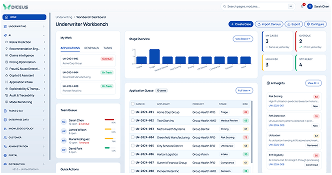
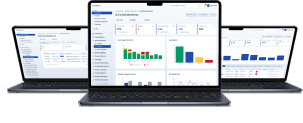
A health underwriting case moves through nine steps, from the moment a submission arrives to the audit trail it leaves behind. Software carries the mechanical parts – reading census files, ordering evidence, scoring risk – and hands the underwriter the judgment calls, with the reasoning attached.
Book a demo
Health underwriting has its own vocabulary, and most of it is doing precise work. Seven terms that appear throughout this page:
Assessing an applicant’s health risk from questionnaires, labs, medications, and clinical records. Distinct from eligibility: medical underwriting asks how much risk a person represents, eligibility asks whether they are entitled to cover at all.
Checking a person or group against the plan and the state rules – waiting periods, exclusions, pre‑existing condition provisions. A case can clear eligibility and still be rated, or fail it regardless of health.
The employee file an employer submits for a group quote: who is covered, their ages, dependants, locations, and plan selections. Most of the manual work in group underwriting starts here.
The minimum share of eligible employees who must enroll for a group plan to be written. A group that fails participation is re-quoted or declined, which is why it is checked before anything else.
An individual whose expected or historical claims are large enough to move the price of the whole group. Identifying them early is the difference between a quote that holds and one that does not.
Per member per month. The unit health underwriting prices in, and the unit cost projections are expressed in.
A case that meets pre-set criteria and is decided without a person touching it. The criteria are configured, not assumed, and everything outside them is routed for review.
Underwriting is a sequence, not a set of features. These are the nine steps a health case passes through, in order, and what happens at each one.
Applications, census files, and broker packets arrive in one queue
The system reads the documents and builds the case from them
Structured assessment of the evidence, with specialist referral where needed
Plan and state rules applied to the person or the group
Expected cost and use, with the drivers shown
Underwriting outcomes turned into a number the broker can read
The system proposes, the underwriter decides
The decided case becomes a policy without re-keying
Everything above, recorded in a form somebody else can check
Group health is where the manual work actually is. A single employer renewal can mean a census of several hundred people, participation rules that decide whether the case is writable at all, and a handful of claimants who move the price of everyone else. The nine steps above apply, with four differences that matter.
Find the right solution for your needs
An employer submits a 200-person census for annual renewal. Here is what happens before the underwriter opens the file, and what is left for them to decide.
A census of 200 employees with dependants, plan selections, and the prior year’s claims experience, sent by the broker as a spreadsheet and a PDF packet.
It reads both, validates the census against the plan, checks participation, aggregates member risk to group level, flags the high‑cost claimants, and builds a risk‑adjusted price.
Not two hundred rows. Four exceptions, each with the reason attached, the projected PMPM beside last year’s, and a recommendation with its drivers listed.
They accept three exceptions, adjust one counteroffer where the loading looks heavy against the market, and close the case. The reasoning is recorded as they go.
Eligibility rules, waiting periods, and pre‑existing condition provisions are set by plan design and by state law, not by software. What a system can do is apply them consistently and show its working. Where this page describes a rule, the rule belongs to the plan or the jurisdiction, and the platform is the thing that applies it.
The process above is how the DICEUS Underwriting Workbench handles health cases, drawn from the product documentation rather than from the market generally. Other platforms sequence this work differently, and a buyer should expect to be shown the sequence rather than told it exists.
This page explains the work. If you are evaluating software to do it, the DICEUS Underwriting Workbench is the product, and its main page covers commercial and specialty lines alongside health. The life configuration is described separately, and group health administration after the policy is issued is a different platform again.