Reinsurance software is the system a cedent or a reinsurer uses to run ceded and assumed business: agreements, premium and claims data exchange, recoveries, settlements, and period close. The DICEUS reinsurance platform, known internally as the Reinsurance Financial and Data Exchange Platform, does all of it in one place.
Book a demo
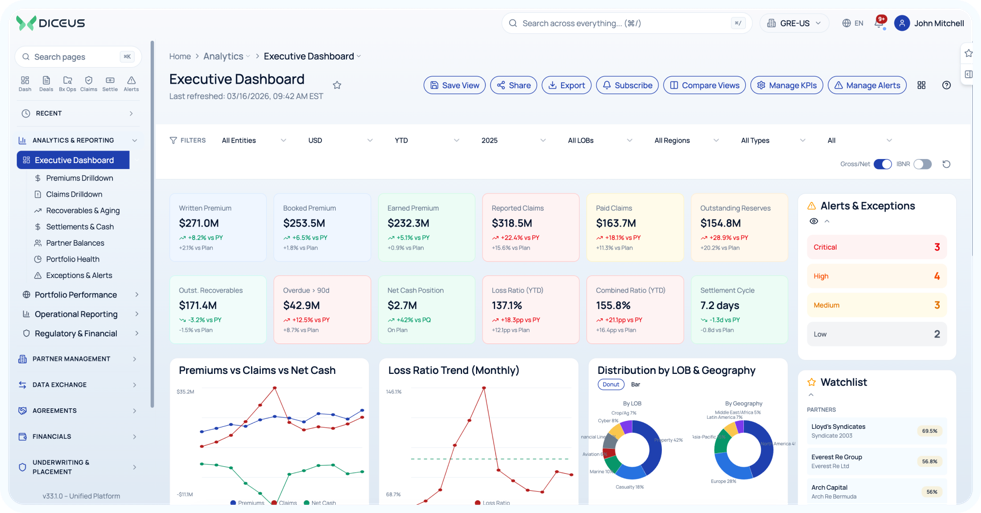
It suits small and mid‑size cedents and reinsurers that already have a core system and need the reinsurance side to stop living in spreadsheets and email. It also suits reinsurers that receive data from many cedents in different formats and need one accepted version.
It is not the right choice if you are looking for a broker placement platform, a replacement for your general ledger, or a single report you could build in your data warehouse.
Cedents, brokers, and reinsurers can use the platform. One side reports ceded business and tracks recoveries, the other validates what arrives and books it. Access is limited by agreement and role.
Most reinsurance reporting still runs on spreadsheets passed between the cedent’s finance team and the reinsurer’s. That works until the files start to diverge.
Three files in circulation and no agreement on which one is final.
Someone assembles them by hand every period, so the close waits on one person.
Booked on the cedent side, never checked against what the reinsurer actually accepted.
The other side keeps working from the figure you already replaced.
When an auditor asks, the trail is in mailboxes rather than in a system.
Data is validated against the agreement as it arrives. Every version is kept, and each figure carries the record of who submitted it and who accepted it.
The platform covers financial data exchange, claims financial management, settlements and accounting views, and — optionally — underwriting and quotation.
Who may see and submit what, controlled by agreement and by role rather than by mailbox.
Treaty and facultative structures, participations, shares, layers and periods. Every figure is checked against them.
File or API submission, validated on arrival, so there is one accepted version of every statement.
Paid, outstanding and recoverable amounts, allocated to layer and reinsurer with shares calculated automatically.
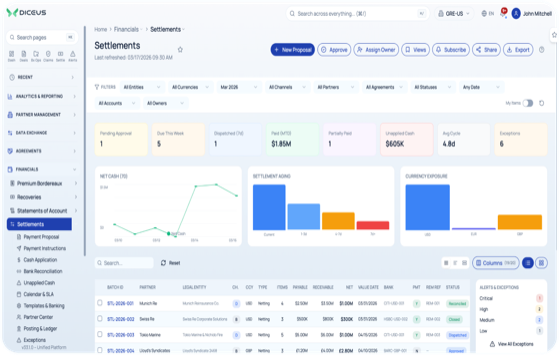
Statements of account, amounts due and payable, and a period that closes without a reconciliation exercise.
A trail that answers an auditor from system state, with every revision kept and comparable.
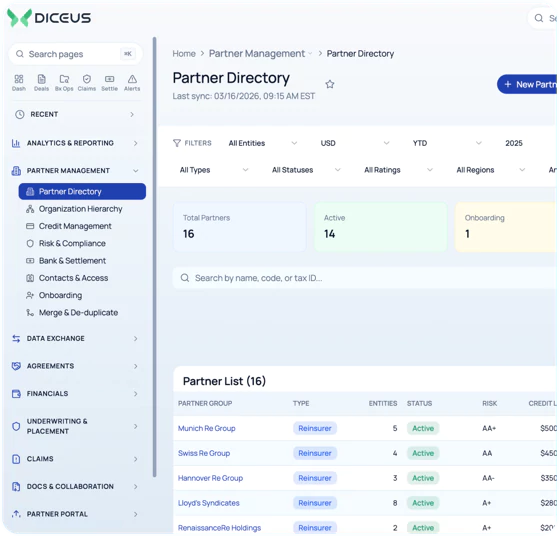
With the DICEUS reinsurance software you manage partners and agreements, onboard a cedent, and control access with optional SSO or MFA. The platform supports detailed treaty and facultative program setup and serves as the reference every financial and claims figure is checked against.
The platform handles financial bordereaux management in multiple currencies. Data is submitted by Excel, CSV or API, checked and mapped against your agreements, and kept with a full version history and a clear status. Comments and audit records make every figure traceable.
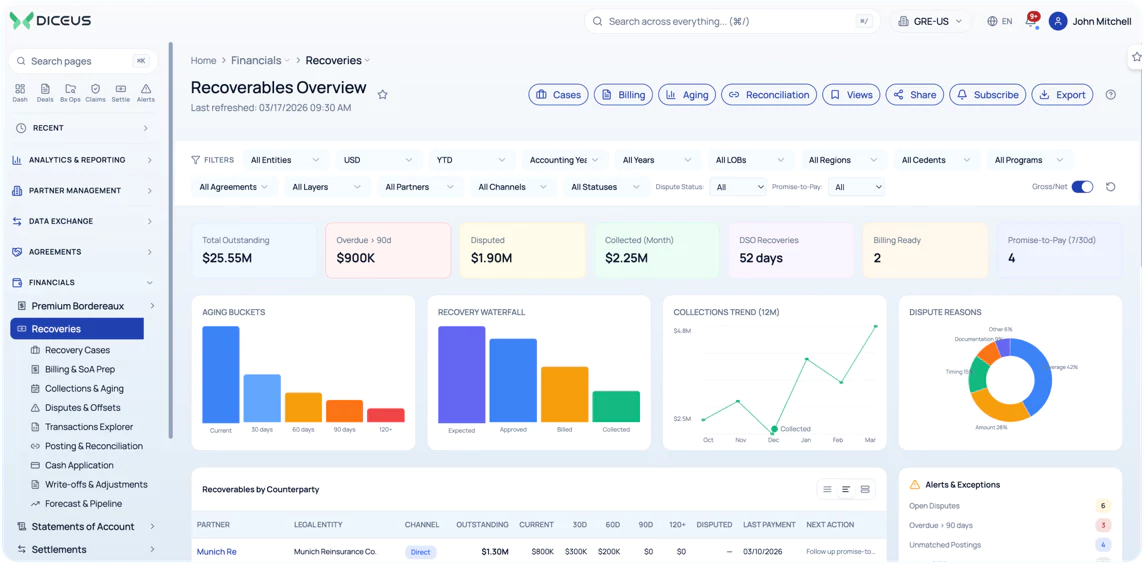
Structured claims financial management gives you a complete view of paid, outstanding and recoverable amounts. It handles allocation at layer and reinsurer level, calculates shares automatically, manages notifications and updates, tracks disputes, and keeps agreement links and a claim‑level audit history.
Because every claim movement is tied to the agreement it falls under, the recoverable position is a system figure rather than a number someone rebuilds at period end.
This module supports financial closure and reporting. Postings stay in your finance system. If you are also looking at the ledger itself, see our insurance general ledger platform.
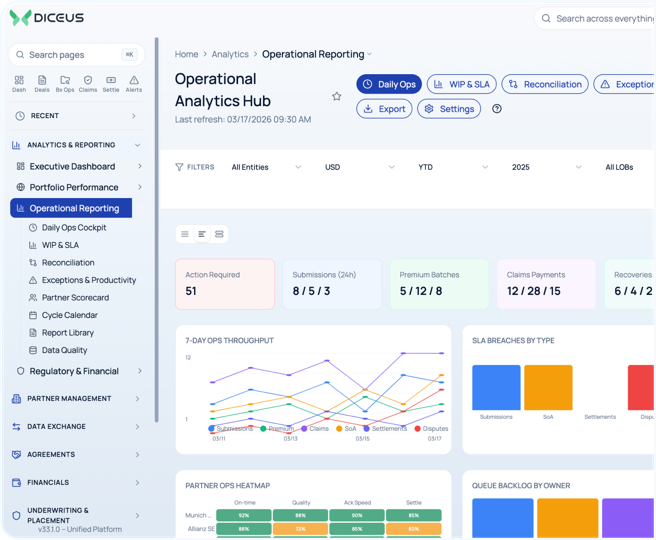
The platform provides audit, control and reporting tools: traceability, data versioning, and structured access for governance. Premium and claims data can be exported by partner and by agreement. For portfolio‑level analysis across lines and years, exported data is usually taken into an insurance data warehouse rather than kept in spreadsheets.
These optional modules extend the platform but are not required for the financial core.
The platform acts as a controlled integration hub and uses ACORD (Association for Cooperative Operations Research and Development) as the data exchange and validation standard between the systems you already run: policy administration, claims, accounting and ERP, and broker platforms.
On the cedent side the data usually comes from a policy administration system and a claims management system. Both can feed the platform directly, so the reinsurance view is built from the same records the business already runs on.
Modular architecture
Separation of internal domain logic
Secure APIs
Layer for ACORD integration
Core finance and claims first
Gradual activation of additional modules
Ability to evolve without redesigning the core
The platform goes in core first: partners and agreements, then financial data, then claims and settlements. Optional modules are switched on afterwards.
We load your treaty and facultative structures, participations, layers, periods and limits. You confirm which agreements go in and the periods they cover.
We map the formats your teams already produce, so nobody has to change how they assemble data. You provide real submissions and statements to map against.
We connect the source and target systems, configure validation rules, and set up roles, access by agreement and authentication.
You name the finance and claims owners who will validate the first close. We run it with them, against real data, before go‑live.
Spreadsheets and core‑suite modules each solve part of the problem. This platform was built around the whole ceded and assumed lifecycle.
You get structured financial control, with data acceptance and settlement rules you can apply. Validation at submission, structured partner onboarding and end‑to‑end auditability are what make it efficient rather than merely tidy.
Yes. Both are set up as agreements with their own participations, shares, layers, periods and limits. Facultative cases are handled individually; treaties carry the recurring structure each period of data is validated against.
Yes. Cedents use it to report ceded business, track recoverables and keep one accepted version of every statement. Access is limited by agreement and by role, so each partner sees only the data that belongs to them.
By file upload or API, with ACORD as the reference for structure and validation. Mapping the formats you already produce is part of implementation, so your teams do not have to change their process before they can start.
With a discovery phase. We take one of your treaties and one period of real data, run it through the platform, and show you what maps cleanly, what the validation rejects, and why.
Yes. Agreements, financial data and claims form the core; quotation, placement and risk support are optional. Any module can be switched on later without rebuilding what is already running.
Open treaties and in‑force participations can be loaded, and so can historical statements. How much history to take is agreed per client, because the useful depth depends on how clean the older periods are.
Cloud, on‑premises, or a hybrid of the two. The model is agreed during scoping and depends on your infrastructure and data residency requirements. Implementation typically takes two to six months.