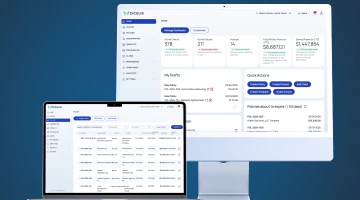
Group insurance management software is where a carrier, TPA, or MGU administers its group book: employer programs, schemes, member enrollment, claims, and billing in one system. DICEUS Individual and Group Insurance Management Platform covers group health and group life.
Book a demoGroup insurance management software is the system a carrier, third‑party administrator, or MGU runs its group book on. It holds employer programs and contracts, the schemes and plans beneath them, member enrollment and eligibility, claims, premium billing, and settlement. One employer group can carry several schemes, each with its own plans, rules, and rates.
Carriers writing employer‑sponsored health and life cover that need one system across programs, schemes, and members, rather than a policy system extended to fit.
TPAs administering books for several insurers at once, where each client brings its own plan structures, eligibility rules, and reporting obligations, and nothing can be hard‑coded.
MGUs running delegated group business who need the administration to hold up to the carrier’s audit as well as their own, with every decision traceable.
Groups operating across several markets and currencies, where local products, languages, and regulatory reporting all have to be configured rather than rebuilt country by country.
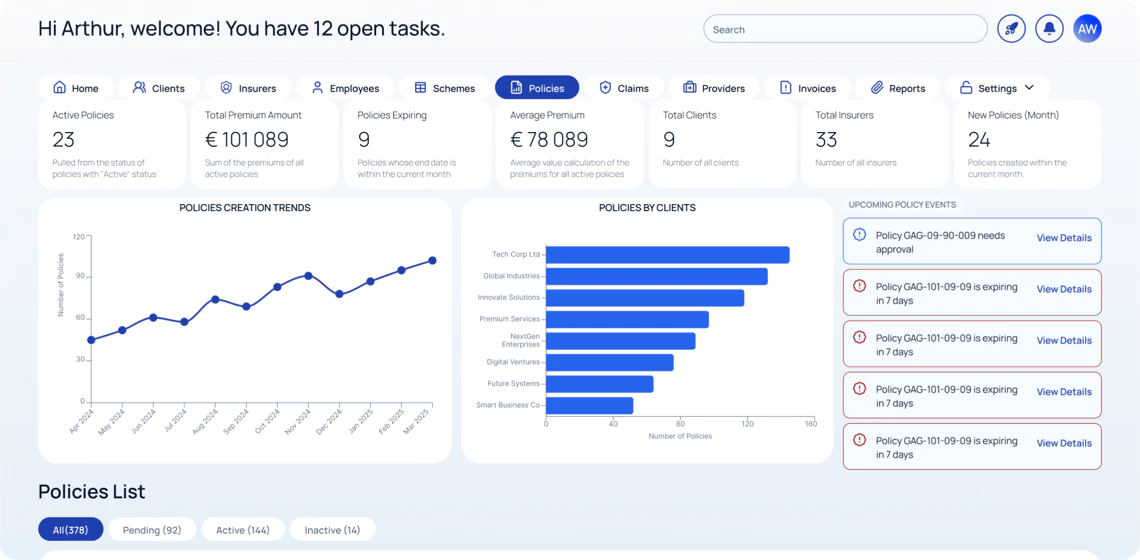
Group health is the deeper of the two books, and the one with the most moving parts. These are the areas the platform covers, from quotation through to provider settlement.
Group life runs on the same employer and scheme structures as health, with its own product configuration, beneficiary handling, and claims. Pension schemes are administered separately, on the page linked below.
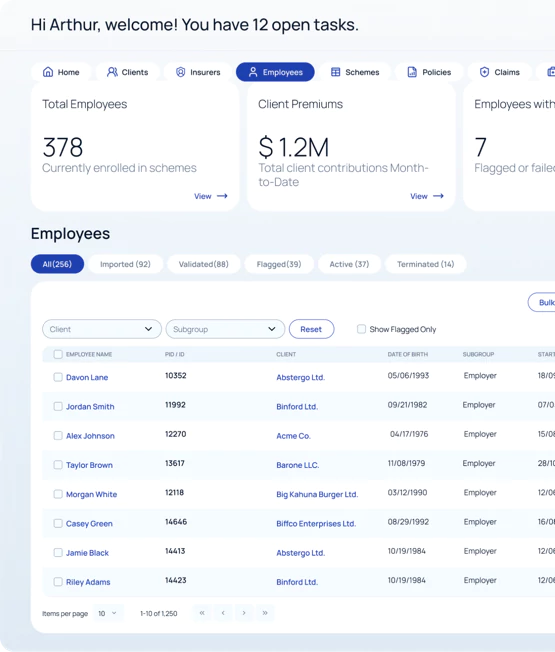
The employer’s HR team reviews members, onboards new joiners, and makes dependent changes without calling the insurer.
Members see their coverage, plan documents, and claim status, and submit claims themselves.
The platform generates and reissues cards, so a lost card isn’t a problem anymore.
Marriage, a new dependent, or a change of address are submitted as requests and validated against eligibility rules.
Policy documents, certificates, and statements reach the people entitled to see them, and only those people.
Brokers and distribution partners get their own view of the employer accounts they service.
Find the right solution for your needs
Three kinds of systems get shortlisted for this job, and they are not interchangeable. This is how to tell which one your situation calls for.
You are the carrier, TPA, or MGU on the contract.
Each employer group brings its own structures, eligibility rules, and rates.
You settle claims and manage provider access.
The organization buys cover for its own staff and needs enrollment and communications.
The system has to be beside payroll and HR records rather than beside a policy system.
A benefits administration suite is the right answer here.
Group sits alongside a much larger individual book and shares most of its processes.
The policy system handles group appropriately and the real gaps are in reporting.
Adding a second system costs more than configuring the one you already run.
The platform is API‑first, with REST endpoints and webhooks, so it runs beside the systems already in place rather than replacing them. Group administration needs data from the employer side as well as the insurer side, which is what makes payroll and HR feeds part of the integration set and not an afterthought.
Products, plans, and benefit structures through the product wizard. Eligibility rules, waiting periods, and underwriting guidelines in the business rules engine. Approval chains, task assignment, and process automation in the workflow configuration. The platform is multi‑tenant, multi‑currency, and multilingual, so a new country or a new administered entity is a configuration. Check out a related product – our policy administration system.
We map the group book as it runs today: employer accounts, scheme structures, plan variants, eligibility rules, and the systems that already hold the data.
Products, plans, benefit structures, eligibility rules, and approval workflows are configured in the product wizard and the rules engine, without custom development.
Core system, payroll, HR, and accounting connections are built against the API, then employer accounts and member records are migrated and reconciled.
Go‑live runs by line or by employer account rather than all at once, with support and configuration handover to your own administrators.
Group administration holds employee and dependent personal data for organizations that are themselves accountable for it. GDPR obligations are built into retention, consent, and subject‑access handling.
Claims and pre‑authorization records are health data, held and transmitted under HIPAA‑aligned controls with restricted access by role.
DORA addresses ICT risk, incident reporting, and resilience testing for financial entities and their providers, which includes a platform administering a group book.
Premium, claims, and settlement data is structured to support IFRS 17 reporting rather than requiring a separate extract and rebuild.
Role‑based access runs to page, menu, and data level, with MFA and SSO through LDAP, OAuth, or SAML.
Every configuration change, claim decision, and data access is logged, so an auditor can reconstruct who did what and when.
Pension scheme administration, fund management, and contributions.
The core system for the individual book that sits beside the group one.
Self‑service portals for policyholders, members, and partners.
Group insurance management software is the system a carrier, third‑party administrator or MGU uses to administer group policies: employer contracts and schemes, plans and coverage structures, member enrollment and eligibility, claims, premium billing, and settlement with providers and members.
A group insurance platform is designed for organizations that carry the risk, so it handles underwriting rules, claims, provider networks, and settlements. A benefits administration system is used by employers to buy coverage.
Yes. Employer contracts, schemes, member records, eligibility rules, and billing are shared, with product configuration, claims handling, and beneficiary management differing by line. Pension schemes are administered separately.
An employer account holds one or more corporate contracts. Each contract carries schemes, and each scheme carries plans with their own coverage structures, limits, and rates. Eligibility rules are at the scheme level, so one employer can run different terms for different staff classes.
Members are enrolled individually or through bulk census upload with validation. Eligibility rules are configured by employment class, location, organizational unit, tenure, and age. When a rule changes, eligibility is re‑evaluated in bulk across affected members rather than record by record.
Claims are submitted by members or assisted by staff, validated for required documents before they move, then triaged, assigned, and dispatched for adjudication. Pre‑authorization and service requests run through the same case management, with provider access rules checked against the employer contract.
The platform holds a directory of providers, clinics, hospitals, and practitioners, searchable by specialty, location, network, and radius. Inclusion and exclusion rules are set per contract, and each provider contract includes its own fee schedules, SLAs, settlement groups, and disbursement batches.
Yes. The HR portal lets an employer review members, onboard joiners, and make dependent changes directly. Members use their own portal for coverage, documents, digital cards, and claim status. Life‑event requests are validated against eligibility rules before they take effect.
This platform is multi‑tenant, multi‑currency, and multilingual. A new country or a newly administered legal entity is set up as configuration rather than a separate deployment, with its own currencies, languages, and branding under one platform.
Yes. Invoices are generated by employer account, contract, policy, and program, on billing schedules with batch runs. Member reimbursements, provider settlement, payment exceptions, and reconciliation are handled in the same place, and the data feeds accounting and general ledger systems.