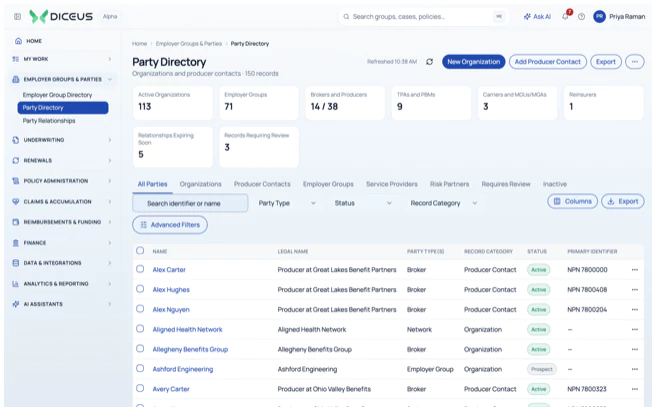
Designed for MGUs and MGAs underwriting under delegated authority, and for the Stop Loss carriers, brokers, and TPAs who work with them. The platform can track one case from submission through underwriting, pricing, policies, claims, reimbursement, and renewal.
Book a demo
The platform is shaped around the processes that consume the week in an MGU, a carrier Stop Loss division, or a program team.
Here are the top eight challenges in Medical Stop Loss operations that are run on email, spreadsheets, and the knowledge of a few people.
Assistants take census and claims data out of broker attachments before an underwriter opens the file.
Work is prioritized in a shared inbox, and authority rules are in a document rather than in the system.
One claimant at a time, with the findings never routed back into pricing, portfolio view, or renewal.
Testing a new deductible, laser, or attachment point means reopening a workbook and rebuilding the scenario.
Every TPA and PBM file has to be validated, normalized, and matched to a claimant, policy, and member.
Missing documents delay payment, and broker status requests take operations time nobody budgeted for.
Weeks of underwriting and operations time go into assembling what should be a query.
Loss ratio, deductible distribution, and broker performance go unwatched between quarterly reviews.
The entire case lives in one place. Medical risk relates to pricing, and claims data is normalized across every TPA and PBM feed before it goes to an underwriter.
Queues, prioritization, referral routing, and authority controls for new submissions.
Claimant‑level risk identification, cost forecasts against the Specific deductible, and laser recommendations that feed directly into pricing.
Specific and Aggregate rating with scenario simulation across deductible, contract basis, and margin, built to work alongside your actuarial manuals.
Validation, normalization, deduplication, and matching of TPA and PBM feeds to claimant, policy, and eligible members.
Running accumulation against deductibles, lasers, and the Aggregate attachment point, with large claim and trigger monitoring.
Notification, documentation, adjudication, approval, payment, and appeal on one record, including interim funding and annual Aggregate settlement.
Issued Specific and Aggregate contracts, versions and endorsements, monthly enrollment, premium calculation, billing, receivables, and commissions.
Automatic consolidation of policy, enrollment, premium, claims, high‑cost claimants, and laser history into a prepared renewal case.
Submission, quote, bind, documents, eligibility, claims, and reimbursement status in self‑service portals for brokers, TPAs, and employer groups.
Loss ratio, deductible distribution, and broker, TPA, and underwriter performance, plus reinsurer bordereaux and the reinsurance share on premium distribution.
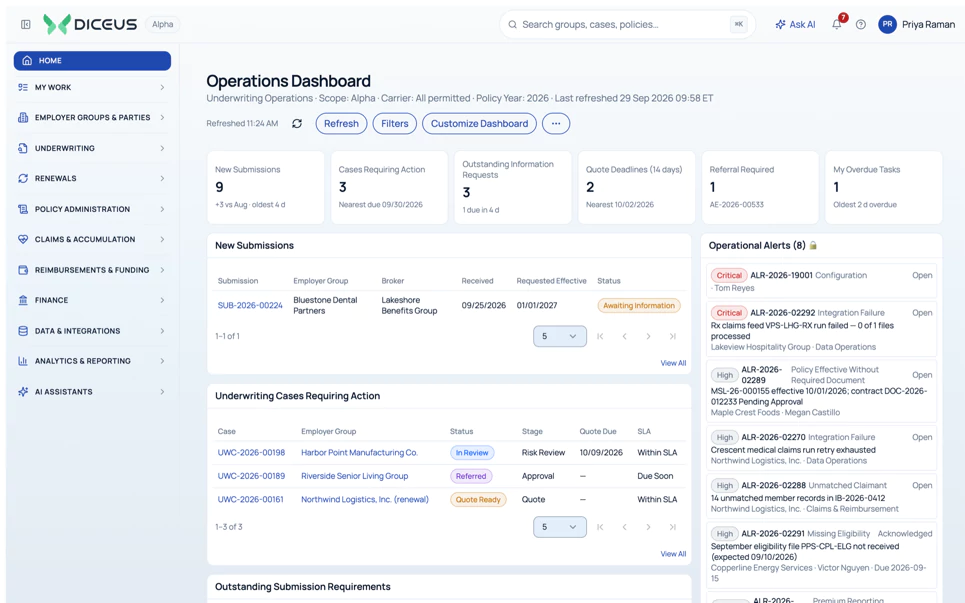
More submissions move through the same team because case preparation and prioritization are no longer manual steps.
Medical risk intelligence is designed to feed pricing and renewal directly, instead of sitting in a separate vendor report.
Policy, enrollment, claims, and laser history consolidate automatically instead of being rebuilt case by case.
Submission, quote, and reimbursement status are available through a portal instead of an inbox thread.
Claims normalization, reimbursement, and renewal preparation run through the platform rather than through the knowledge of one analyst.
Actuarial models, medical risk vendors, TPA claim systems, and reinsurance arrangements connect through APIs, so no big‑bang replacement is required.
Three people in a Medical Stop Loss organization judge a platform differently. Here is what each one gets.
Yes. Modular deployment is the intended entry point for a smaller team. Start with the single workflow that absorbs the most time, usually claims data normalization or renewal preparation, and add from there.
If your in‑house solution really covers the full lifecycle, there is no need to change anything. If your work still depends on workbooks, inboxes, or the people who developed the system, a module usually helps without changing what already works.
TPAs manage the claims and remain just the system of record. The claims data hub ingests and normalizes TPA and PBM feeds so Specific accumulation, Aggregate tracking, and reimbursement work off one consolidated Stop Loss view instead of a separate reconciliation.
Medical risk vendors are strong at claimant‑level intelligence. The difference is where that intelligence is. The DICEUS platform brings the vendor’s output into the underwriting workbench and carries it through pricing, quoting, and renewal.
No. AI helps with submission intake, document reading, data quality checks, and drafting. The platform labels every output and links it to the supporting evidence. A person confirms anything that changes a case. Irreversible decisions are never automated.
For captives, protected cells, funds, and treaty accounting, DICEUS offers its Alternative Risk Platform and Captive Management Platform.