Policy administration software

A policy administration system is the software a carrier, MGA, or TPA uses to run the policy from end to end: configuring the product, issuing the policy, handling endorsements and renewals, and billing against it. DICEUS policy administration software is a licensable, implementation‑ready version of that system. You activate the modules you need and connect them to the systems you already run.

Book a demo
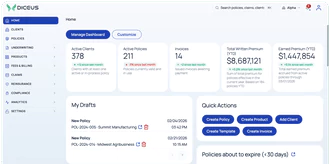
DICEUS policy administration software dashboard

Who it is for

  • 01

    Traditional carriers

    Launch new products without delays. Keep all your policy, billing, and claims data in one place.

  • 02

    Managing General Agents (MGAs)

    Handle the entire policy lifecycle, including issuance, endorsements, and billing. Run it on your own system instead of a carrier‑provided portal you cannot configure.

  • 03

    Third‑party administrators (TPAs)

    Manage policies and claims for multiple carriers or clients using the DICEUS system. Configure products, authority, and reporting separately per client.

Who it is not for

This is policy administration software, so it is not the right fit in three cases. If what you need is a claims system rather than policy administration, that is the claims management module, not this one. If you need submission intake, risk scoring, and quoting, that is the underwriting workbench. And if you run a retail insurance agency rather than a carrier, MGA, or TPA book, an agency management system will fit your work better than this will.

What’s slowing down your operations

  • Policies are run in spreadsheets

    Policy renewals, endorsements, and COIs are performed manually. That slows turnaround and creates errors that later become compliance exposure.

  • Insurance data is disconnected

    You don’t have a single view of a policy’s status, premium, and claims history. They must collect data from multiple systems, which slows decisions and frustrates policyholders.

  • Every new product and state filing takes months

    Monolithic systems make it expensive to configure new products, coverage, or jurisdictional rules, so market opportunities close before the system can catch up.

  • Purchasing a full platform means paying for capabilities you don’t need

    Traditional carriers, MGAs, and TPAs often have to purchase large enterprise systems with all available functionalities instead of the specific modules they really need.

Effective policy administration workflow

  • 01

    Configure products and policy templates.

  • 02

    Create or extract policies.

  • 03

    Review, confirm, and issue.

  • 04

    Manage mid‑term changes as they occur.

  • 05

    Bill and reconcile.

  • 06

    Renew policies as they fall due.

  • 07

    Monitor and act on the dashboard.

Key modules

Policies

Policies are created based on products, with coverage and limits specified. Each policy is generated using a pre‑saved template and clearly reflects essential information such as the insured’s name, the insurer, premium amount, and status. Users can filter policies by status and premium type, track effective and due dates, and quickly identify policies that need renewal. With capabilities such as bulk creation, certificate generation, and renewal, users can manage large volumes of policies efficiently.
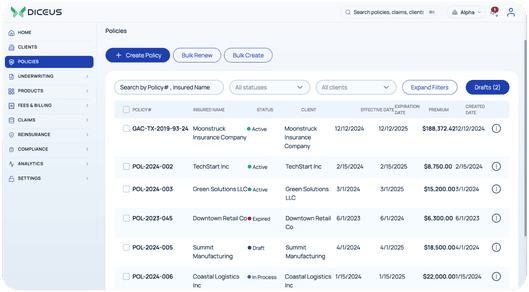
Policies module

Billing

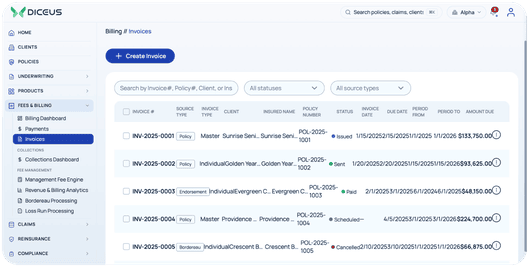
Insurers can easily create, manage, and track all invoices in one place. Users can filter invoices by different parameters. Each invoice record provides access to additional actions, such as viewing full details or downloading a PDF copy for record‑keeping purposes. With built‑in search, filters, and a clear layout, the dashboard streamlines financial oversight, helping ensure timely and accurate premium collections.

Billing module

Products

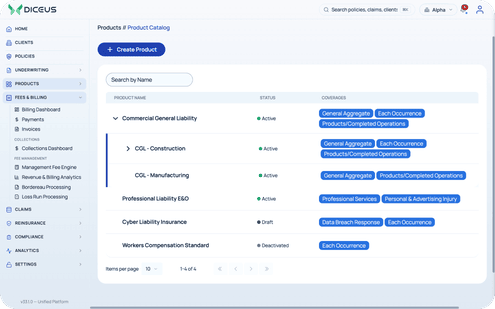
Insurers can create and manage insurance products, with a hierarchical view of all product families, enabling them to easily create root or sub‑products. Each product can be configured to meet specific laws, regulations, and markets, and, if needed, support coverage types, custom fields, and multiple versions.

Products module

Client management

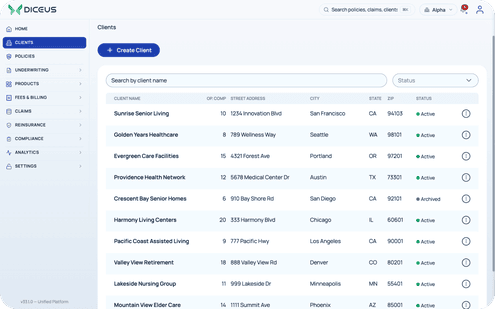
Clients are held once and reused across every policy. The module covers client and multi‑entity management, so a client group with several legal entities is one record, with client‑specific custom data, additional insured management, and client‑level access control and permissions.

Client management module

Main dashboard

Begin your journey with a powerful, user‑friendly dashboard that displays portfolio performance, including data on policies and claims, billing, and customer interactions. Real‑time updates, visual analytics, and intuitive navigation allow users to track policy performance, claim progress, and premiums. Our insurance policy administration system provides clear insights into policy status distribution, monthly premium trends, and recent activity, enabling smarter decisions and more efficient operations.

AI‑powered policy data extraction

What if a commercial policy PDF could turn itself into a ready‑to‑review policy draft, without anyone retyping a single field?

Our solution connects with one of the popular AI assistants via MCP. It reads an uploaded policy document and creates a matching policy in the system. The assistant locates the correct client, operating company, and product version, maps coverage limits, premiums, and insured risk objects straight from the PDF, flags a potential duplicate policy number, and presents a full field‑by‑field summary for human confirmation before the draft is created.

Claims and underwriting

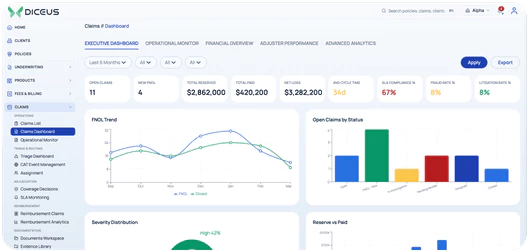
Claims and underwriting are handled by their own DICEUS modules and are documented on their own pages: claims management software and underwriting workbench. Policy administration shares the same client, product, and policy record with both, so coverage and limits in force are read directly rather than re‑keyed.

Claims dashboard

Want to see our insurance policy administration system in action?

Book a demo

What you can configure yourself

Most of what slows a new product launch is configuration work that must be booked for development. In DICEUS policy administration software, products, coverage types, clause terms, default limits, deductibles, premiums, retro dates, rate plans, document templates, and custom fields are all configured in the system, versioned, and published through an approval step. Product versions can be activated, deactivated, archived, or deleted, with dependency validation so that a version in force cannot be removed by accident. That is what makes a new product or a jurisdictional change a configuration task rather than a release.

Lines of business

The system is not tied to one line. Products, coverages, clause terms, document templates, and custom fields are configured per product and per line, so property and casualty, life, and other lines run in the same system with their own rules, and you add a new line by configuration rather than redevelopment. Group health and group life benefits administration is a different product and is covered by the DICEUS group insurance platform.

Key features

Below, you’ll find an overview of the essential features that distinguish our configurable solution from other market platforms for managing insurance operations.

Policy creation and management

  • Dynamic policy creation with configurable coverages and terms
  • Retro date management at the policy and coverage level
  • Endorsements: creation, editing, versioning, approvals
  • Mid‑term endorsements generate new policy versions automatically
  • Policy version history with timestamps, user tracking, and audit log
  • AI‑powered PDF‑to‑policy data extraction
  • Automated policy PDF and deck page generation
  • COI (Certificate of Insurance) generation with mapped limits
Policy creation and management

Product and coverage configuration

  • Multi‑level product hierarchy with versioning
  • Coverage types with clause‑term configuration
  • Editable default values for limits, deductibles, premiums, and retro dates
  • Document templates stored per product version
  • Activation, deactivation, archiving, and deletion with dependency validation
  • Custom fields at various levels
Product and coverage configuration

Invoicing and billing

  • Invoice creation and sending by email
  • Invoice PDF generation and downloading
  • Invoice exporting to an accounting platform
  • Payment creation
  • Credit and debit memo workflow
  • Loss ratio calculations
  • Retro premium calculations
  • Integration with exposure and bordereaux
  • Financial performance analytics
Invoicing and billing

Client management

  • Client creation and management
  • Client‑specific custom fields
  • Additional insureds adding and editing
  • Access control at the client level

Platform

  • Role‑based access following your organizational structure
  • Full audit log of every change, with user and timestamp
  • Notifications and document delivery
  • Document storage against the policy and the client record

Integrations

DICEUS can integrate PAS with the systems insurers already use – from e‑signing and accounting to AI‑assisted data extraction – and scale it further as your operations grow.

Core carrier systems or legacy PAS

The policy record stays in step while the legacy system is still in use, which is what makes a phased migration possible instead of a cutover.

Implementation

Launching the platform doesn’t require a big‑bang rollout. Because the DICEUS PAS is modular, you can start with the functionality you need and add the rest as your processes grow.

How long it takes depends on how many functionalities you need. Implementation runs from four weeks to six or nine months, and the exact timeline is agreed upfront rather than estimated as the project goes.

That range covers configuring the modules you have chosen and migrating an agreed scope of data. Replacing a multi‑line core system across a whole book is a larger program and is scoped separately.

  1. Discovery.

    We map your current product lines, policy workflows, and existing systems to define which modules to implement first.

  2. Configuration.

    Products, coverages, rate plans, and document templates can be configured in the system to match your existing product catalog and rules.

  3. Data migration.

    Data is migrated from your legacy system or spreadsheets, with validation checks to catch any gaps.

  4. Integrations.

    The system can be integrated into your rating engines, payment gateways, accounting systems, and other tools you use.

  5. Launch.

    Rollout can be phased by module, product line, or business unit.

Deployment and security

The deployment model is agreed during scoping and depends on your infrastructure, data residency, and IT requirements. Whichever model you choose (on‑premises, cloud, or hybrid), the functionality and configuration options are the same.

Access is role‑based and follows your organizational structure and approval thresholds, so people see and approve only what their role allows. Every change, approval, and version is recorded against the policy with who made it and when, and policy history is immutable. Security and compliance controls are agreed with your IT and security teams during implementation and adapted to your policies and regulatory environment.

The platform is built to support GDPR, DORA, HIPAA, and IFRS 17 requirements, and the specific controls in scope are agreed with your compliance team during implementation.

How DICEUS policy administration software compares

DICEUS policy administration software
Full core insurance suite
Spreadsheets and a legacy system
Custom‑built
The functionalities you choose, implemented as you need them
The suite, including modules you will not use
What you already have
Everything, built from scratch
Configured in the system, versioned, and published through approvals
Configuration, usually with vendor or partner involvement
Manual work in documents and spreadsheets
A development release
Every version, change, and approval recorded against the policy
Recorded
Reconstructed from files and email
Whatever you build
Four weeks to six or nine months, scope dependent, agreed upfront
A multi‑year program for a full core replacement
Not applicable
Typically several years
Read by an AI assistant and drafted for review
Varies by vendor
Retyped by hand
Whatever you build

Benefits

DICEUS policy admin software delivers automation, transparency, and flexibility for real business impact.

  • 01

    Automated policy management

    Our policy administration system offers numerous policy management automation capabilities, including creating and renewing policies, e‑signing documents, providing reusable templates, tracking versions, generating various reports quickly, integrating data from external tools and systems, and more. By automating most tasks, insurers can save time on repetitive jobs and focus on value‑added activities, reduce the risk of human error, and adapt quickly to new market opportunities and business rules.

  • 02

    One record for the whole policy

    Policy status, premium, documents, and billing are in the same record, so a renewal question is answered from one screen rather than assembled from three systems. Where the claims and underwriting modules are in use, they read the same client, product, and policy data, which is what removes the reconciliation work between them.

  • 03

    Data‑driven decision‑making

    Reporting tools and real‑time dashboards provide insights into key metrics, including premium trends, policy statuses, and loss ratios, enabling faster, data‑driven decisions and performance monitoring. Also, they help identify underperforming products or emerging risks, allowing insurers to take corrective actions proactively. Interactive dashboards can drill down into specific segments, visualize trends, and highlight areas where operational or financial strategies need adjustment.

  • 04

    Fast time to market

    Insurers can create products faster because our system offers a set of ready‑made functionalities and established logic, so you can respond to market demands without waiting for a development release.

DICEUS has built insurance software since 2011 and has licensed its own insurance products since 2024. The policy administration system is available on the Microsoft commercial marketplace, and the company works with Microsoft, Google, and Oracle.

See how the product works

We will walk through configuring a product, issuing a policy, endorsing it, and billing against it, using the modules that match how you work.

Book a demo

Frequently asked questions

What is a policy administration system in insurance?

A policy administration system is a ready‑made solution that helps insurers manage policy administration efficiently, with speed and visibility. It holds product definitions, policies written against them, endorsements and renewals, and billing, so each policy has one record for its entire lifecycle. Carriers, MGAs, and TPAs can all use it, and the difference is usually how much they can configure without asking a developer for support.

What are the key modules included in the system?

Our PAS includes modules for handling policies, products, billing, and clients. Claims and underwriting are DICEUS modules licensed separately, so you take them only if you need them. You can start with one module and add others later without rebuilding the whole system.

Can the system help with managing insurance products?

Yes, the product management module allows insurers to create and manage insurance products with precision, offering a hierarchical view of product families and customization options for coverage types and multiple versions. Product versions are published through approvals, and you can’t accidentally remove a version in force.

How does the system enhance billing and invoicing processes?

The system provides a transparent billing experience, with tools to manage, monitor, and restore invoice activity. These tools include manual and automatic invoice generation, export to an accounting platform, tracking of invoice statuses, and credit and debit memo workflows. Loss ratio and retro premium calculations run against the same data, so finance and underwriting read the same numbers.

Can we buy only the policy module instead of a full core suite?

Yes. The modules are licensed separately and we implement what you need, so a carrier that only wants policy and billing is not buying claims and underwriting to get them. What usually decides the scope is which systems you are keeping: the integration work is what makes a partial footprint worth doing rather than a problem. We scope that in discovery before anything is signed.

Can it work alongside the core system we already run?

Yes, and for most carriers that is how it starts. The policy record is kept in step with the legacy system through the integration layer, so a line of business or a product can move across while the rest stays where it is. That is also what makes the timeline shorter than a core replacement – nothing has to be switched off on day one.

How long does implementation take?

From four weeks to six or nine months, depending on how many functionalities you need, and the exact timeline is agreed upfront rather than discovered along the way. That covers configuring the modules you have chosen and migrating an agreed scope of data. A full multi‑line core replacement is a different kind of program and is scoped on its own.

Does it support life insurance as well as property and casualty?

Yes. Lines of business are a configuration rather than a separate installation, so property and casualty, life, and other lines run in the same system with their own products, coverages, and documents. Group health and group life benefits administration is a different DICEUS product and has its own platform.

Let’s talk about your project needs

gartner
5/5
6 reviews
clutch
4.9/5
49 reviews

    Contact us

    100% data privacy guarantee

    Thank you!
    Your request has been sent
    We will get back to you as soon as possible

    USA (Headquarters)

    +19293091005 2810 N Church St, Ste 94987, Wilmington, Delaware 19802-4447

    Denmark

    +4566339213 Copenhagen, 2900 Hellerup,
    Tuborg Havnepark 7

    Poland

    +48573568229 ul. Księcia Witolda, nr 49, lok. 15,
    50-202 Wrocław

    Lithuania

    +37069198546 Vilnius, LT-09308, Konstitucijos ave.7
    6th floor

    Faroe Islands

    +298201515 Smærugøta 9A, FO-100 Tórshavn,
    Faroe Islands

    Austria

    +4366475535405 Handelskai 92 - Rivergate - 1200,
    Vienna

    UAE

    +4366475535405 Emarat Atrium, 423 Al Wasl Area, Dubai,
    P.O. Box 112344

    Jordan

    +962787500100 Swafeya, Waklat St. 2, Office 302,
    Amman