How life insurance underwriting works

A life case is decided by evidence and by rules. The evidence is medical and financial, and it has to be ordered before it can be assessed. The rules turn what comes back into a class and a table rating. Software runs most of that and shows its reasoning.

Book a demo AI-Powered Underwriting Workbench for Life Insurance

What these words mean

Life underwriting runs on a vocabulary that is precise and largely unexplained anywhere public. Seven terms that appear throughout this page:

APS

Attending physician statement. A report requested from an applicant’s own doctor, covering history, diagnoses, and treatment. It is the slowest item in most life cases, because it depends on somebody else’s office.

How a life case moves, in nine steps

The live page lists what the platform has. This lists what happens, in order, and where each capability does its work.

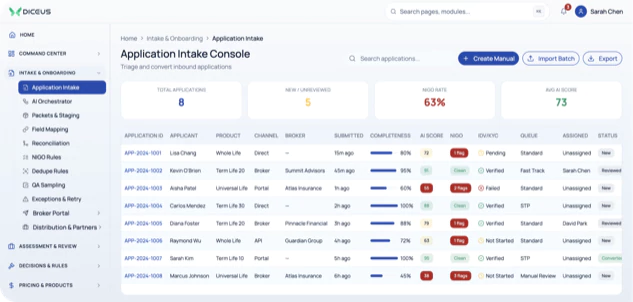
  1. Intake and triage

    Applications arrive from four channels and are scored before anyone opens them

    • Direct, broker, portal, and API submissions
    • Completeness scored on arrival
    • Not-in-good-order cases identified
    • Identity and KYC checks
    • Routed to a queue and an assignee
    Application Intake Console in DICEUS Underwriting Workbench
  2. The applicant in full

    What the underwriter needs to know before reading a single lab result

    • Coverage already in force
    • Prior submissions and declines
    • Earlier evidence and case history
    • Related parties and household
    • Compliance flags in one place
  3. Requirements and evidence ordering

    The slow part, managed rather than chased

    • Requirements set by the age and amount matrix
    • Vendor orders and appointments tracked
    • Reminders and follow-ups automated
    • SLA by stage, with escalation
    • Cross-case console for bulk action
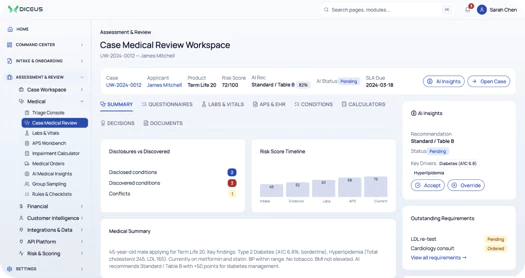
  4. Medical underwriting

    Clinical evidence assessed in one connected workflow

    • Labs, vitals, and questionnaires
    • APS and EHR records
    • Disclosed conditions against discovered ones
    • Guideline and calculator‑assisted assessment
    • Referral to a medical director where needed
    Case Medical Review Workspace in DICEUS Underwriting Workbench
  5. Financial underwriting

    Whether the cover makes sense for this applicant’s circumstances

    • Income and employment verified
    • Assets, liabilities, and debt ratio
    • Affordability against requested face amount
    • Beneficiary and insurable interest validation
    • Business and key person analysis
  6. Rules and classification

    Where judgment becomes a decision that can be repeated

    • Product-level risk appetite
    • Age and amount matrix
    • Eligibility and jurisdiction rules
    • Classification into class, table, and flat extra
    • Rule sets versioned and governed
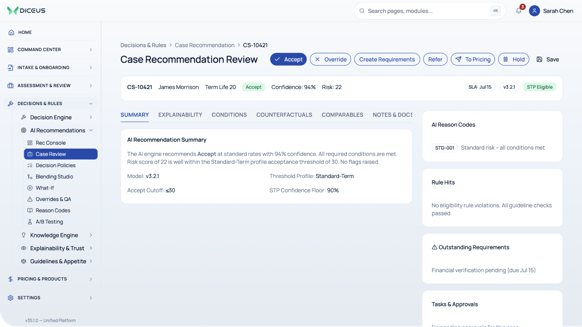
  7. Recommendation

    The system proposes with its reasoning exposed, the underwriter decides

    • Accept, rate, postpone, or decline
    • Confidence score and named drivers
    • Reason codes and rule hits
    • Counterfactual and what-if analysis
    • Comparable historical cases
    • Accept or override, on the record
    Case Recommendation Review in DICEUS Underwriting Workbench
  8. Pricing and offer

    The decision turned into a premium and a document a broker can use

    • Premium with component breakdown
    • Illustration builder and projections
    • Scenario comparison
    • Reinsurance impact simulation
    • Offer versioning and approvals
  9. Straight-through processing and issuance

    Low-risk cases finish without a desk, under controls that can be pulled

    • Preconditions configured, not assumed
    • Automated decision execution
    • Auto-offer within pricing guardrails
    • Issuance readiness validated
    • Handoff to policy administration
    • Exception, retry, and kill‑switch controls

Accelerated underwriting, and what has to be true for it

Accelerated underwriting is often described as skipping the medical exam. That is the outcome, not the mechanism. What actually happens is that a case is tested against preconditions, and only cases that clear all of them are decided on reduced evidence. The preconditions are where the risk is controlled, and they are configured deliberately.

What the case has to clear

  • Age and face amount inside the matrix
  • Risk score under the configured cutoff
  • Confidence above the configured floor
  • No eligibility or jurisdiction rule hit
  • Evidence complete, with no conflicts

What stays in place when it does

  • Every decision recorded with its reason codes
  • Model version attached to the outcome
  • Exceptions routed to a person
  • Controls that can stop the automation

Find the right solution for your needs

Talk to our expert
Illia Pinchuk CEO and Founder of DICEUS

Example case

A 42-year-old applies for $500,000 of twenty‑year term cover through a broker. The figures below are from the product’s own demonstration data, not from a client.

  1. What the evidence shows

    Two conditions disclosed, three discovered, one conflict between them. Type 2 diabetes with an A1C of 6.8 and hyperlipidemia are the drivers. An LDL re-test and a cardiology consult are outstanding.

  2. What the finances show

    Declared income $185,000, verified at $178,500. Debt‑to‑income 18.2 per cent, premium at 4.8 per cent of income, $250,000 already in force against a maximum allowable face of $5.55 million.

  3. What the rules return

    Age and amount put the case inside the matrix. The medical findings classify it to standard with a table B rating rather than preferred. No jurisdiction or eligibility rule is hit.

  4. What the underwriter gets

    A recommendation of standard with table B, the two drivers named, the rule hits listed, and the two outstanding requirements flagged. They accept, or they override and say why.

Where this comes from

Accelerated underwriting is a supervised practice, not just a product feature. The National Association of Insurance Commissioners has published guidance on how insurers should govern it, and the Society of Actuaries has published research on how regulators approach it. Both are worth reading before buying anything.

Underwriting classes, table ratings, and the age and amount matrix are industry conventions rather than DICEUS inventions. What differs between platforms is how the rules are expressed, who can change them, and whether the reasoning behind a decision survives the decision. Those are the questions worth asking of any vendor, including this one.

The nine steps above describe how the DICEUS Underwriting Workbench sequences life cases, taken from the product documentation. Another platform will order the same work differently. A buyer should expect to be walked through the sequence on real screens rather than told that it exists.

Where to go next

This page explains the work. If you are evaluating software to do it, the DICEUS Underwriting Workbench is the product, and its main page covers commercial and specialty lines alongside life. The health configuration is described separately. Brokers and agencies get their own view of submissions and offers through the same platform.

See a real case move through all nine steps. Book a demo with our underwriting team.

Book a demo

Let’s talk about your project needs

gartner
5/5
6 reviews
clutch
4.9/5
49 reviews

    Contact us

    100% data privacy guarantee

    Thank you!
    Your request has been sent
    We will get back to you as soon as possible

    USA (Headquarters)

    +19293091005 2810 N Church St, Ste 94987, Wilmington, Delaware 19802-4447

    Denmark

    +4566339213 Copenhagen, 2900 Hellerup,
    Tuborg Havnepark 7

    Poland

    +48573568229 ul. Księcia Witolda, nr 49, lok. 15,
    50-202 Wrocław

    Lithuania

    +37069198546 Vilnius, LT-09308, Konstitucijos ave.7
    6th floor

    Faroe Islands

    +298201515 Smærugøta 9A, FO-100 Tórshavn,
    Faroe Islands

    UAE

    +19293091005 Emarat Atrium, 423 Al Wasl Area, Dubai,
    P.O. Box 112344

    Jordan

    +962787500100 Swafeya, Waklat St. 2, Office 302,
    Amman