

Webinar recap: Beyond Excel – Automating Financial Operations for Alternative Risk Companies
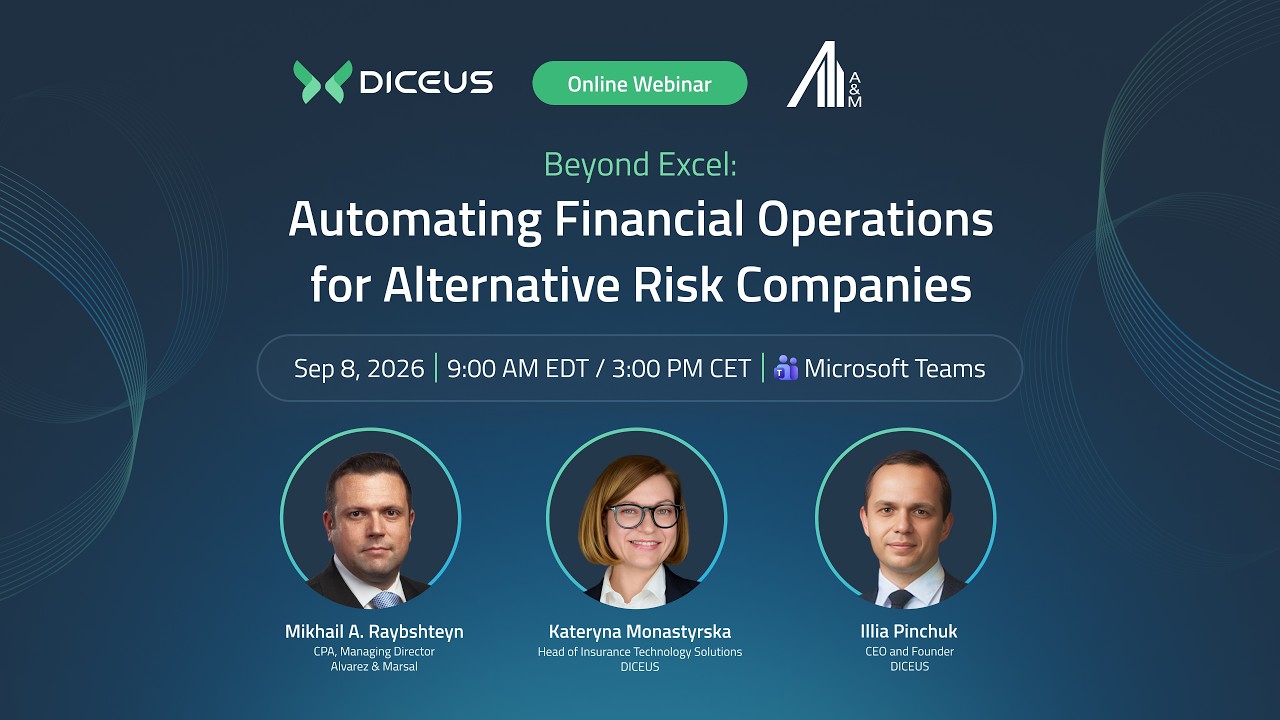
Recently, DICEUS hosted an online webinar “Beyond Excel: Automating Financial Operations for Alternative Risk Companies.”
DICEUS Head of Insurtech Solutions, Kateryna Monastyrska, was joined by Illia Pinchuk, CEO and Founder of DICEUS, and our guest speaker, Mikhail Raybshteyn, Managing Director at Alvarez & Marsal, to talk about why captive managers, risk retention groups, program administrators, and fronting carriers still run critical financial workflows on Excel, Word, and institutional memory, and what actually changes that.
Missed the session or want to revisit the discussion?
Watch the full webinar recording here:
The discussion focused on three key topics: where the pain in day-to-day financial operations actually shows up – version control chaos, broken audit trails, key-person dependency – what typically triggers an organization to finally move off spreadsheets, and what a scalable financial operation looks like once they get there.
A working example of taking financial operations beyond spreadsheets is realized in the DICEUS Alternative Risk Platform’s financial operations module. It replaces the manual layer: rekeyed journal entries, hand-assembled board packs, disconnected investment statements – with one connected data flow:
- Ledger automation – premium and policy data post directly into a purpose-built ledger through configurable accounting rules, with an allocation engine splitting premiums, expenses, and losses across entities or cells and a full audit trail on every entry.
- Reporting – financial statements, board packs, and participant statements generate from that same ledger through a custom report builder, instead of being reassembled by hand each cycle.
- Investment data – portfolio evaluation, accrual management, and multi-captive allocation feed through the same pipeline, so investment income lands in the books on day one of close instead of ten days later.
The goal isn’t a smaller team. It’s giving the same team the ability to take on more clients, cells, or programs without adding headcount every time the business grows. If you want to see our platform in action, feel free to contact us.
Below is a transcript of the webinar.
Kateryna: Hello, everyone, and welcome. Thank you very much for joining us. I’m Kateryna, I lead insurance technology solutions at DICEUS, and I will be hosting today’s webinar. It is a conversation between people who have spent their working lives inside the financial operations of captives, risk retention groups, protected cell companies, program administrators, and fronting carriers. We want to talk about where that work still runs on Excel, Word, and institutional memory, and what actually changes it. I’m joined today by two guests. First, Illia Pinchuk, CEO and founder of DICEUS. Illia, welcome.
Illia: Thanks, Kateryna. Good to be here. Since 2011, I have been leading DICEUS, an insurance technology company providing configurable, implementation-ready platforms for commercial, specialty, and alternative risk insurance operations.
Kateryna: And our guest speaker, Mikhail Raybshteyn, Managing Director at Alvarez & Marsal in New York. Mikhail specializes in insurance tax and alternative risk finance strategy, including captive insurance consulting, and advises global insurance, reinsurance, captive, insurtech, and diversified financial services organizations on complex tax and risk finance matters. Mikhail, thank you for joining us. Welcome.
Mikhail: A pleasure to be here. Thank you for having me.
Kateryna: Over the next hour, we will cover where the pain actually lives in day-to-day financial operations, what typically triggers an organization to finally move off spreadsheets, and what good looks like once they do. We will leave time at the end for your questions, so drop them in the chat as we go. So let’s start with the shared problem. Whether you are a captive manager, a risk retention group, a protected cell administrator, a program administrator, or a fronting carrier, the pattern tends to look the same. The book of business grows, but the financial operations behind it may still run on Excel, Word templates, and whatever a couple of long-tenured people happen to remember. Mikhail, you see it across a lot of these organizations from the tax and advisory side. What is your role and interaction with financial operations within captives, RRGs, and their managers?
Mikhail: Sure. As you mentioned, we get a cross perspective from pretty much every facet of the operations, because of what we do within tax, within financial accounting advisory, and within regular consulting and operations. That goes from setting up a captive from the start to assisting a cross-border insurance company, a domestic risk retention group, or even MGAs and operators of captives or alternative risk finance solutions.
We are tasked with helping our clients set up or reform their financial processes. That means data flow, inputs and outputs, and how all of those work together to get you to the most efficient, most appropriate, most correct answer. Without, call it, manufacturing defects in the financial services process, where you have to rework and go back. So our view stems from knowing what data should go in and comparing it to what actually goes in. And the same goes for the outputs. So the view is very rounded.
Kateryna: In your experience, how universal is this “still running on Excel” problem across the organizations you have worked with?
Mikhail: I wouldn’t necessarily call it a problem. Every system, every software, every platform has its own set of risks. Excel has its own. Platforms have their own. I do think the world agreed that a process built on Excel may be a bit outdated for some organizations.
It’s a fair statement that Excel is still very prevalent inside most organizations. It’s part of the software package, part of operations, part of the process. That is not easy to just lift out and move away from. But there are ways to use Excel to help you with your processes, rather than relying on it as a crutch.
If we look at insurtechs, fintechs, a lot of areas with the newest startups, those organizations tend to walk away from Excel more. They may not even use Excel to begin with. There are plenty of other platforms and systems that can substitute for it. You can still import and export information to or from Excel for some quick analysis, but that’s not the same as using Excel as a foundational piece of software for your organization.
So, setting aside the word “problem” and looking at it more as a process, we see a lot of Excel usage at commercial carriers, reinsurers, operators of captive insurance companies, and companies that take information from captive managers and import it into their own systems. That crosses tax departments. It crosses investment files you get from investment managers. It may cross loss runs from bordereaux systems and the analytics on them. And certain modeling: where is my captive, or where is my tax as a commercial carrier, going in the next five years if I implement this or that? There were plenty of models when the Tax Cuts and Jobs Act came in, showing how that tax would impact the operations of a group or a company.
Now, Excel is susceptible to human error, and it’s more labor-intensive than some of the systems. Used correctly, it can be helpful. But a lot of companies, at least from what I see with my clients, are relying on Excel a bit too much for daily tasks that some of the newer systems may be more suitable for.
Kateryna: That’s a great grounding point. Illia, anything you would add from the platform side before we go deeper into where specifically this pain shows up?
Illia: Yes, I’d like to add one thing from the platform side. What we see is that it’s almost never the whole operation running on Excel. It’s usually the critical workflows between systems and teams that don’t scale well. For example, financial data movements, allocations, reporting, entity-level operations, and the manual processes around growing the business. We will come back later to what actually changes that.
Kateryna: Mikhail, from what you do, advising on tax, structuring, and financial reporting, walk us through where this bites: information flow, the auditor’s and advisor’s perspective, financial reporting, tax reporting, and filing.
Mikhail: Well, let’s think about the process, right? What does every company want? The company wants an efficient process. The company wants good data. The company wants to have its fingers on a proverbial button that you can push and get the information. Can you design all of that on Excel or other parts of the Microsoft suite of products? Yes, absolutely. It’s more labor-intensive than packages you can add on top, but that doesn’t mean it’s a bad answer for every organization. In certain types of organizations, you do need to rely on these tools, depending on the industry you’re in, the number of entities you have, the number of people you have. The leaner you are, maybe the more you rely on systems. The more people you have in your department, maybe the more you rely on products that have been around longer rather than newer systems. And of course, it all depends on the financial budget of your organization. Can it afford to change something at a particular moment?
However, if we go back to the premise, each organization wants good data in, good data out. They don’t want auditor questions like: how does this number get from one place to another? How do you trace this information? They want to know: how do I work with my tax consultants so I can give them tax-sensitive information in an easier manner, one that shortens the time to do the tax provision, prepare the tax return, file the return, and then book the return-to-provision? Or, if I’m planning to open another company, buy a subsidiary, or investigate whether a captive is feasible for my organization, how do I give a consulting firm the data it needs in a manner that’s easily digestible, that reduces the hours they spend looking at the data and, obviously, reduces the fees for the organization?
The notion of doing what’s informally called SALY, same as last year, year over year, may not be as workable nowadays as it was 15 or 20 years ago, when technology was growing slowly. You could buy a laptop, and two or three years after you bought it, it was still a good laptop. Now you take a laptop off the shelf, go to the register, and by the time you pay for it, the laptop is outdated. The technology boom is obviously moving very fast with the introduction of AI and everything else, so companies need to think about adjusting for that.
So what are the key things? Most importantly, version control. I’m sure many people who work in organizations doing a financial close or a project have been on version 57 of an Excel model, or version 157. I’ve had version 257 in some cases. And you’d better pray that nobody changed version 256 before you started updating version 257.
That typically creates issues with audit trails. There are definitely situations where auditors simply cannot follow the direction of a flow or find supporting information. Not because it’s not there, but because it’s not intuitive and you cannot necessarily see the supporting documents or where they came from.
Then analytics. You want to have your fingers on the proverbial button, right? Almost like that Staples button: “That was easy.” Everyone wants to have that, but in some cases we keep building systems or processes that don’t allow for it. So that’s something to think about for organizations that want scalability and, at the same time, ease of access to their data.
Then financial reporting, as I mentioned, followed by the tax provision, filing the tax return, booking the return-to-provision, giving everything to your auditor, filing financial statements with regulators, and making sure you can answer regulators’ questions when and if that time comes during financial audits. How all of that data is kept, processed, and provided is something some organizations only think about when the question is asked, not as processes are being built.
For new organizations, it’s almost upon them to think: how can I make this process easier for myself as I’m building it? For organizations that have been in place, more financial and operational decisions need to be made. Is it worth it for me? The answer may or may not be yes, but it is a conversation that needs to be had in most organizations, if not all.
Kateryna: And from your point of view, where does the most time get spent: actuarial work, loss runs, board pack assembly, tax and financial reporting, or statutory filings?
Mikhail: That depends. If you take 100 companies, I don’t think there’s one good answer. It really depends on the company. There are companies that have a very good actuarial process, and their actuarial and underwriting departments can provide data very easily. I’ve seen many organizations where investments are the toughest part: getting information from the investments department and analyzing it, because it may not be organized in a tax-sensitive way. So that part may be a bit of a black hole, and companies spend more time there.
In some cases, it’s organizing all the data that comes into the tax department, making sense of it, making sure the data is correct, and making sure you have the latest versions, so there’s one version of truth for the organization.
So it depends on the organization. Are you in-house, the tax, controller, or finance department of a major carrier or a reinsurer? Or are you a captive manager with 100, 200, 600 captives? Does your system enable you to quickly look across all your captives and identify potential reporting issues? How quickly can you raise a red flag and say something is off before it gets into clients’ hands and before it gets into regulators’ hands?
So I don’t know if there’s one particular issue across the whole gamut. It does depend on the organization, and that’s a conversation companies need to have internally: where are the biggest pain points for us? It may not be all the processes, but from my experience working with clients, it’s definitely at least one or two.
Kateryna: Can you share a specific example where a spreadsheet error or gap caused a real problem: an audit finding, a delayed close, a miscommunication with the board or a regulator?
Mikhail: Oh, I definitely don’t think we have enough time to list all of them, but I will share a few. Surprisingly enough, they happen pretty much every day. Some of them are very minor and can be quickly fixed. Some of them are a bigger challenge, and some of them may have a really bad ripple effect on the financial process.
A few came to mind as I started thinking about this before the call. I had a client where, granted, this was a bit back in the day, the auditor dropped the physical file they got from the client, and the papers inside flew everywhere. The auditor quickly scrambled, put all the papers back together, went back to the audit room, and then couldn’t make sense of how the supporting documents supported the tax provision that had been handed to them. Something that simple. It happened because the process wasn’t very efficient. It wasn’t technologically advanced. It was hard-copy work papers, and it wasn’t that long ago. That issue could have been avoided if the process had been a bit more efficient. Not necessarily using a particular platform, just a bit of efficiency and maybe technology in the process.
Version control, we talked about that. Working on version 56 when someone is already updating version 57. Which version did you update? And now we have two or three versions flying around. That’s typically one of the biggest problems for companies that model in Excel and constantly send files back and forth. That’s why a lot of companies are moving to shared spaces and shared files, where at least you potentially work on the same file.
The lack of transparency. Even nowadays, when things are a lot more technologically advanced, a lot of auditors’ questions come down to: where is this coming from? How can I trace the number? Can I observe you performing a transaction? A lot of times, re-performing the transaction raises questions like: if you click on this, where does this number go? “Oh, no, it doesn’t really go anywhere. It just stays here, and we have to retype it into the next system.” Well, that creates potential for human error. The same goes for tracing tax filing adjustments, making sure your return-to-provision is booked correctly, and then rolling your financials forward.
I’ve definitely seen plenty of this, and I must say it’s probably more on the captive insurance side. Because captives are generally smaller relative to the size of the parent organization, some processes may not be extended to them, or to how the data travels from the captive manager to the organization. Things may get lost in translation, and errors may happen.
And then there’s, of course, the “hit by a bus” factor that every organization talks about. There used to be books on the shelves of companies about what happens if this person quits, what happens if we have a fire, what happens if, if, if, right? So the hit-by-a-bus factor is: what if your chief Excel engineer, the person who knows the file best, gets hit by a bus? It’s not meant to be morbid. But if that person quits or, God forbid, something happens to them, who can pick it up? Do you know the passwords to that Excel file? Can you make sure that everything works together? Can you take the model and move it forward?
There are plenty of others, but those are the key examples of where we can see potential for disconnects.
Kateryna: So the one or two people who know the workbook become a tax, audit, and compliance risk. Thank you for that. And how does data quality, loss runs, capital tracking, affect the tax and structuring options available to a captive or an RRG?
Mikhail: With bad data, you make assumptions on that bad data, whether it’s late or just hard to understand. And that process then finds its ripple effect in your financial statement close. It finds its way into your tax return file.
Now, every system is prone to errors. We’ve definitely seen clients that use some of the most advanced systems and then had a bug in the system, and that bug caused a number to fall off. In one of the most notorious examples I had, everything was divided by 10 because the last zero fell off every number. Sort of an easy thing to fix, right? But when you submit your financials and instead of a billion it becomes 10 times less, that creates an issue for the board. If you don’t realize it and present the financial statements to the board, somebody looks at them and goes: why are we 10 times smaller than we were a quarter before? What’s happening here? Even if it’s an easy fix, it raises the question: why wasn’t it caught before? So the efficiency of the process can be significantly hampered by bad data that went into it, no matter how efficient your process is.
So can Excel sometimes be an easier way to go? Yes. But is it more prone to human error? It depends. It depends on how much attention you pay to it. If you constantly do it, it may be the greatest thing for a particular organization until, going back to my last point, somebody gets hit by a bus and that person is no longer there to do it, to teach someone, or to pass on the knowledge of “here is how I do this process.” Because there’s still a lot of that going on. In small organizations, not so much. At captive managers, not so much. But in large organizations, commercial carriers, reinsurers, and certain very large risk retention groups, the process still sits with a few people.
Kateryna: So let’s connect that to scale for a moment. At what point does a growing book of entities, programs, or cells start to break the spreadsheet-based approach?
Mikhail: That’s a great question. In some organizations, depending on the number of people involved in a process, it can be going from two companies to five companies. In other cases, organizations that have people minding this every day can scale up to 100 and be fine. And then once you buy your 101st or 102nd subsidiary, it becomes a challenge.
But to me, the question is not even so much when Excel breaks. The question is how you make the process more efficient. Sitting on the consulting side, at the beginning of pretty much every project we have a conversation with our clients about scope and fees. And I’m sure folks who are listening and are on the consulting or service provider side have similar conversations. How much will it cost me? How long will it take? Well, cost and time are derivatives of the quality of the data, the quality of the process, and how quickly you can manipulate data, move it around the system, and give it to someone in a tax-sensitive or financial-accounting-sensitive manner. Can you break the accounts into the items you really need to know for financial reporting, for reporting to your counterparties and regulators? If you’re a reinsurer, how quickly can you get access to the data from the fronting carrier in order to do your underwriting faster and make it better? A lot of that depends on the data, and a lot of it depends on the processes you set up.
So again, when does Excel break? I don’t think there’s a formula, and I don’t know if anyone has tested at which point Excel is no longer a viable model. I think it’s part of the overall package. But when the process is designed, someone needs to give very strategic thought to how that process is designed and where Excel comes in. Because I think it’s still a needed part: exporting into it, doing certain reports, analyzing certain things quickly. There’s not going to be a button built for everything at any particular moment.
But where do you scale? The answer will be different inside an organization versus for captive managers and other service providers that may use Excel in a different way. So it needs to be a decision for the organization. But what I would definitely caution companies is: don’t wait until that last moment, when you feel the boat starting to leak and Excel breaking, and only then start modeling how you will operate next year. God forbid I take on one more client and my system will not be able to handle it.
And the same applies to systems too, not just Excel. There are systems with scalability that has a finite point, after which you need to upgrade the system or do something else. I think these discussions need to be almost annual. How are we going to operate next year? What are the challenges we faced this year? Almost like a post-mortem debrief every time you close your financial statements: what could we have done better? I think that question should drive the organization’s approach to what we need to do next year, in the next three months, in the next six months, to be competitive and to be scalable.
Kateryna: So the pain is real. What gets an organization to move off spreadsheets? In our own conversations, we consistently hear: growth outpacing headcount, an audit finding, a regulator or reinsurer asking for cleaner data, a key person leaving. Mikhail, what’s your opinion? What’s the moment an Excel-based financial operation breaks? Is it usually growth, an audit finding, a treaty renewal, or someone leaving? Which do you see most often? And maybe, what’s the most expensive mistake you have seen from staying on spreadsheets too long?
Mikhail: The majority of what I see are issues with process or data flow when it comes to the financial reporting close, tax returns, or other regulatory filings. Whether it’s income tax returns or indirect tax returns. In the alternative risk finance and captive insurance space, there are certain regulatory taxes, self-procurement tax being one of them, that may be overlooked or not considered by some companies until questions start arising. And when questions come in, it becomes: how do we get the data? How do we analyze that data? Is it the correct data?
So I see it in regulatory and compliance filings. I see it in the financial statement close process, obviously, because things take longer. Thinking back to working with my audit counterparts at my previous firm, they always mentioned that if a certain process were in place, or if the company augmented its process even by a little, part of the close process or the entire close process would have been faster. Faster by days, sometimes by weeks. A lot of companies have a very robust financial close process, but that doesn’t mean the data is that much better. They are just trying to crunch and analyze that data in a faster-paced environment.
As for the most costly mistakes: I don’t think anyone would say the sky is falling if you need to amend your tax return. But operational deficiencies or defects cause companies to lose part of their operational reputation. If the board finds out that the tax director constantly files tax returns with information that’s not 100% correct, or that could have been better if someone had augmented the process, slowly that raises other questions.
So costly mistakes are underpayment of taxes, or overpayment of taxes, because you paid too much to the government and didn’t have the ability to invest that money. Loss of confidence by shareholders or counterparties if you file financial statements that are not fully accurate, or you have to restate them. Especially if you have to restate them, if mistakes happen once every year or once every two years. Things start to accrue, and folks start asking questions: is it the process? Is it a person? Is it the organization just not caring? Whatever the answer is, going back to the ripple effect, there’s a ripple effect throughout.
The question is, what will cost you more? Is it your reputation in the market? Is it someone’s job, because leadership will start asking why things keep coming in wrong? Is it securing your next line of credit or next financing, because the bank or lender cannot trust the accuracy of your financial statements? All of that can be costly. For some companies, it may be the difference between staying in business and running out of cash and not getting additional funds. Or losing a counterparty on a deal. Or not being able to provide data to the government, whether federal, foreign, or state, and paying fines or penalties. Or delaying the audit process, which costs time and money, even if it’s implicit money, for everyone involved in that audit.
Everything has its cost. I think the level of that cost is organization-specific.
Kateryna: Thank you for that. Illia, does that match what you hear when you first talk to a prospective client? What’s usually the actual trigger that gets them on a call?
Illia: In my experience, companies rarely start with the thought “we need new software.” Usually something pushes them to change.
The first and most common reason is growth. I spoke with a captive manager who told me very simply: the more clients they add, the more people they need to manage the work. They wanted to grow without increasing the team at the same speed.
The second reason is forced change. Sometimes the current system is being discontinued by the vendor, so the company has to find a replacement. In another case, a parent company was moving the business to a new general ledger, but the team knew it would not really support the way they operate.
And the third reason is when an internal custom-built system is taking too long. One group captive manager had been building a system for more than a year, but the business was growing faster than the product was being delivered. At that point, they were not really looking for new software. They were looking for a way to move forward.
So usually the trigger is one of three things: growth, a forced system change, or a solution that is not keeping up with the business.
Kateryna: Let’s talk about the other side of this. Not the pain, but what a scalable, automated financial operation should look like once an organization gets there. What do good financial operations look like for an alternative risk company at scale? And what’s the difference between automation that removes real hours and automation that’s just a nicer-looking spreadsheet? Mikhail, what’s your take on it?
Mikhail: I like to compare this to folks who buy a house versus the ones who build their own.
On one side, you have folks who go and look at a house, and they like it. They like certain parts of the house, how the doors look, where the outlets are, how the kitchen is structured. They figure that for the next few years this will be sufficient for them, and they make some upgrades. On the other hand, you have folks who buy a lot of land, design the plan, and start building a house. And they will meticulously, or hopefully meticulously, think through the doorways, where the kitchen is in relation to the entrance, how wide the outdoor deck is, where the pool is going to be, how many Wi-Fi routers or Ethernet ports, back when we used to plug things into a wall, where the light switches are, and everything else.
And guess what? The people who buy the house that was already built make some upgrades and are content with what they’re living in. Whereas the folks who build a house, the minute it’s built, do a walkthrough and say: I should have put a closet there. I should have put an outlet there. I should have put a light fixture there. I know plenty of folks and real estate agents who’ve been part of that building process, and not a single one completed a house and said: oh, this looks fantastic, this is everything I ever wanted. 90% is there, 95% is there, but you still want to fix things.
So, equating that to what good looks like: it does depend on the organization. Believe it or not, I had an insurance company that used QuickBooks for its general ledger. I thought I’d seen everything. After that, I’ve pretty much seen everything. I never thought I’d see QuickBooks being used by an insurance company. But they did. It was a smaller company, and for them it sort of worked, but let’s face it, it was the bare minimum. For them, even a moderate improvement, maybe Copilot and Claude if those had been available at that point, plus Excel and other Microsoft packages, would have been a big step up. So for them, good would have been just a really robust Microsoft package with some databases and everything else.
For bigger organizations, if you’re talking about commercial carriers and commercial reinsurers, the names we’re all familiar with, take the Fortune 100 companies around the world and separate out the insurance and insurance-adjacent companies, as I call them. They’ve long moved past that version of good. They’re not using just a basic Microsoft package or basic Excel. For them, a new custom-developed software system may be what good looks like, right? We all remember Guidewire implementations across the insurance industry. For some, that was what good looked like.
So it really does depend. I think what good looks like is defined by whether you are achieving your operational goals. Are you achieving your client acquisition goals? Are you achieving your joint venture partner and business partner goals, doing what you’re supposed to do with that particular business partner? And that can apply even to procurement systems. Some companies have procurement systems that are really outdated, and that stifles the growth of the business, because they can’t hire consultants or operate with those consultants fast enough. Everything is delayed by months, hopefully not years, but definitely by months. So for those companies, good may be that step. Or for companies that operate really well but file their tax returns on the last day, or overpay their taxes because their estimate process is not great, maybe good looks like gaining 10, 15, 20% margin on that process.
So I think it’s defined by how well you operate and what your immediate pain points are. Companies should ask exactly that question, just without comparing themselves to another company. You compete with yourself. We tell that to athletes, we tell it to our kids, whether it’s in school, on a golf course, or on a training mat: you compete with yourself. Do the best you can. You can always find someone better, but do the best you can, and if you put in hard work and do what’s right, you will get there. Not everyone can be an Olympic gold medalist. Not everyone will be a star golf player. But you can be good without being number one.
When it comes to systems and operations, I honestly don’t believe there’s a number one. I don’t think there’s an Olympic gold medalist among companies, because every company has its own issues, its own risks, its own situations where it needs to adjust and pivot. Especially in this economy, in this political environment, in this world we live in, risks and changes come every day, where they used to come every month or every year. Things change very quickly, sometimes on an hourly basis.
So I think what good looks like is a driving question for companies. How much can I improve? And where is the inflection point where spending more money only gets me diminishing marginal returns? If I’m improving margin by 20% by spending a dollar, but I could improve my bottom line by 40% by spending that dollar somewhere else, well, maybe that’s what good looks like. And then you try something else. So it’s a good question, but I think it’s specific to each organization.
Kateryna: Clear, thank you very much. And that frames it well: audit trail, faster close, less dependency on one or two people, and the ability to onboard new entities without adding headcount in proportion. Illia, DICEUS works on exactly this layer with an alternative risk operating platform. Can you briefly frame what that looks like in practice?
Illia: Yes. I see a lot of captive managers and alternative risk companies still running their financial operations on a mix of QuickBooks, NetSuite, or Excel. For example, a premium comes in, and someone manually creates a journal entry to get it into the general ledger. There is no live connection between the policy side and the financial side. Investment statements arrive from custodians in whatever format the custodian uses, and someone rekeys them. Quarter-end workbooks, board packs, and participant statements get assembled by hand from four or five disconnected sources. One captive manager put it simply: the more clients we take on, the more staff we need to manage the process. Growth doesn’t get cheaper under this model. It literally gets more expensive in headcount.
Our platform’s financial operations module removes that manual layer. Premium and policy data flow into a purpose-built ledger automatically through configurable accounting rules, with an allocation engine to split premiums, expenses, and losses across entities or cells, and a full audit trail on every entry.
Then financial statements, board packs, and participant statements are generated from the same ledger through a custom report builder, without being reassembled by hand each cycle.
And investment data feeds through the same pipeline, with portfolio valuation, accrual management, and multi-captive allocation. So investment income lands in your books on day one of the close instead of day 10.
So the goal is not to reduce the team. It’s to help the same team handle more clients, cells, or programs without having to add more people every time the business grows.
Kateryna: Thank you very much, Illia. A reminder that you can ask your questions in the chat, and I will bring them in. As we wrap up, let’s pull out a couple of closing thoughts. Mikhail, what do auditors and examiners ask for now that they didn’t, let’s say, five years ago?
Mikhail: I don’t think I have a top three or top five list of things specific to the last few years versus the last 10 or 15. But I think the focus is more on: can this process survive if someone leaves? There’s much bigger turnover at companies now than 10 or 15 years ago, when folks stayed in their roles for 5, 10, 15, 20, 30, 40 years. So it’s the longevity of your process, its survivability, the continuity of your business in general. How can you continue the business and make sure you don’t make financial mistakes if that key person or those key people leave the company and you have to pivot immediately? I think that’s one of the bigger topics.
The other one is meeting all the compliance matters, not so much financial, with new regulations and new rules, not just in the United States but around the world. New cross-border taxes, regulations, tariffs, whatever the case may be. Are you meeting all your compliance requirements? We see that more and more in financial and tax due diligence projects. Has the company filed everything? Are there penalties for things they didn’t file? Are they entitled to something if they join a particular group? Are they subject to some penalties if they join a particular group? I think those are top of mind generally. I wouldn’t want to speak for my audit counterparts, but that’s what I see in the projects I’m involved in, where these questions arise.
Kateryna: And where do you see the biggest gap today between how fast this industry is growing and how ready the back office is to support that growth?
Mikhail: I do think the back office is still a bit behind. The innovation and forward thinking of companies, here’s what I want to insure, here’s what I want to design, here’s how I want this to operate, still outpaces the ability to support that in a manner that allows further innovation. I don’t think the back office is far behind. I do think there are improvements that can be made. Operational data connectivity and certain checks and balances can be improved. But is it far behind? No, I don’t think so, and I wouldn’t want to position it that way.
But for the alternative risk finance industry especially to grow, I think it’s upon us, members of the industry, to think through what improvements may need to be implemented, so that the industry can continue to evolve, proliferate, and do better. We’ve seen tremendous growth in the captive insurance and alternative risk finance space, so I think it’s on us to help companies do that.
Kateryna: And if a CFO or a controller could fix one workflow in the next 12 months to cut audit and tax risk, what should it be?
Mikhail: That’s a challenging question, and I wouldn’t want to speak for CFOs and controllers. But typically the question comes down to how much time we spend on a process and how much it costs us. So look through that lens and figure out what would help most to make the process efficient and cut costs. Or, to Illia’s point, how do I take on 10 more clients without hiring 10 more people? Because that obviously cuts into the margins and exponentially increases the cost of service. That’s the lens I would look through. What the solution is, that’s for companies to decide, and that’s why they hire consulting firms to help them assess. But companies need to look through that lens to at least start moving in the direction of making that improvement.
Kateryna: Thank you very much. We have covered the topic, and the recording will be sent to you by email. We don’t have any questions in the chat, but some people prefer to communicate directly, so if you have any follow-up questions, feel free to reach out to us. Mikhail, Illia, if I receive any questions for you directly, I’ll be happy to share them with you. Thank you very much for joining us today, Mikhail, for your examples, your expertise, and your thoughts. Illia, thank you very much for sharing your experience. Thank you, everyone. Goodbye.
Mikhail: Thank you so much for having me. Take care. Bye, everyone.
Illia: Thank you.


